

China All-Steel Ceramic Antistatic Floor: Your Comprehensive Guide to High-Performance Flooring
2026-11-02
A single static discharge can corrupt data, damage sensitive equipment, or even halt production in critical environments. That's why all-steel ceramic antistatic flooring has become a go-to solution for facilities across China and beyond. If you're comparing high-performance options, Lipin Floor offers a range of antistatic floors engineered for durability, safety, and long-term value. This guide breaks down what to look for before making your choice.
Why All-Steel Ceramic Floors Outlast Standard Antistatic Options
The longevity gap comes down to what sits on top. Standard antistatic floors usually rely on a thin conductive laminate or vinyl layer that carries the static-dissipative rating. Under rolling loads, chair casters, dropped tools, and daily foot traffic, that surface is the first thing to wear through. Once the coating or laminate is scratched deep enough, the path to ground gets interrupted and the panel becomes just another piece of flooring that has to be replaced.
All-steel ceramic construction removes that single point of failure. The ceramic surface is fired into a hardened layer that resists abrasion, moisture, and chemical spills at a level thin vinyl cannot match. Beneath it, the steel core holds its shape under heavy point loads without cracking or delaminating. Because the steel itself is part of the grounding system, there is no reliance on a fragile top film to maintain electrical continuity.
That combination matters most in environments where floors are treated as equipment, not just surfaces. A standard antistatic panel may look fine for a year or two before its edges start peeling or its resistance values drift. By contrast, all-steel ceramic panels tend to stay dimensionally stable and electrically consistent for the full life of the facility, which means fewer replacements, less downtime, and no quiet loss of protection when traffic is heaviest.
The Ceramic Layer’s Real Job in Static Dissipation
Most people assume a ceramic layer in static-sensitive assemblies exists to block charge outright. That misses the point. The layer is less a wall and more a controlled leak path. Its real job is to spread localized charge across a wider surface so the energy density drops below the threshold that damages sensitive circuits. By tuning the material's volume resistivity, designers let electrons migrate just fast enough to prevent buildup, without turning the layer into a conductor that would short nearby traces.
The choice of formulation matters more than thickness. A layer that is too insulative traps charge at the surface and creates a field strong enough to punch through thin dielectrics. A layer that is too conductive invites crosstalk and leakage currents. The effective range typically falls between 10^6 and 10^9 ohms per square, depending on the discharge rate and the capacitance of the device.
What makes the ceramic layer effective is not that it eliminates static, but that it buys time. It lets charge bleed away gradually, holding the surface potential low while the system operates. This is why the layer is often paired with grounding pads or chassis connections—those contact points give the current somewhere harmless to go. Without that return path, even a well-engineered ceramic layer would simply store the charge until it found a more destructive exit.
Buying Guide: Spotting Quality in Chinese Manufacturing
中国工厂的质量水平差异极大,报价最低的几家往往在同一批货里混入不同等级的材料。别急着下单,先让对方寄来实物样品,做破坏性测试或至少拆解一个成品,看看内部焊点是否均匀、螺丝有没有滑牙。图片和视频可以修,但拿到手里的东西骗不了人。
验厂比看证书有用。ISO 9001之类的认证在很多小厂只是挂在墙上的装饰,实际流程可能完全不同。直接问他们最近一次客户投诉是怎么处理的,或者要求提供过去三个月的来料检验记录。如果对方支支吾吾,或者只给你看成品率数据,就要警惕了。好的工厂会主动告诉你哪些环节容易出问题,以及他们加了什么防错措施。
细节能暴露管理漏洞。注意螺纹边缘有没有毛刺,电镀层是否在孔位附近变薄,包装盒上的批次号是否清晰可追溯。这些微不足道的地方,恰恰是低成本工厂最容易忽视的。另外,别相信预约好的参观,对方有足够时间把乱糟糟的产线收拾干净。突击视频连线,或者找个本地朋友突然上门,看到的才是真实状态。
Installation Mistakes That Undo Antistatic Protection
Most techs know the basics: wear a wrist strap, use a grounded mat, handle boards by the edges. Yet failures still happen because the grounding path isn't what it appears to be. A mat that's plugged into a wall outlet's ground may be floating if that outlet is miswired or if the ground pin is corroded. The same goes for the alligator clip on a wrist strap that's snapped onto a painted chassis or a plastic bench frame. When the path to earth is broken, every movement builds charge, and the first component you touch becomes the discharge point. It's worse than having no strap at all because your caution drops to zero.
Another silent killer is the antistatic bag itself. Those silver or pink pouches are designed to shield components during storage, not to serve as a work surface. The outer layer is conductive, and the inner layer is insulating. If you lay a populated board on top of the bag while testing or soldering, the exposed pins on the underside can bridge across the conductive surface, shorting power rails or killing backup batteries. Use the bag only for transport; once the board is out, place it on a proper dissipative foam or grounded mat.
Then there's the human factor that no tool can fully override. You might be wearing a wrist strap, but if it's loose over a shirt sleeve or the coil cord is stretched beyond its rated length, the resistance climbs and the strap stops bleeding charge fast enough. Meanwhile your other hand holds a screwdriver with an insulating handle, and your feet shuffle on carpet. A sudden reach to plug in a connector can deliver a zap through the board instead of through the strap. Before touching anything sensitive, touch a bare metal chassis or a grounded water pipe, and keep the room's relative humidity above 40%. Static loves dry air, and so do dead CMOS chips.
Keeping the Conductive Path Intact During Maintenance
Routine maintenance often creates unintended breaks in the conductive path, especially when components are disconnected for cleaning or inspection. Bolted joints may loosen slightly after thermal cycling, and oxide layers can form on terminal surfaces without visible signs. A technician who simply reassembles parts without checking contact pressure or surface condition may leave behind a resistance path that only shows up later under load.
Before reconnecting any conductive interface, wipe both mating surfaces with a non-abrasive pad and apply a thin layer of anti-oxidant compound if the environment is humid or corrosive. Use a calibrated torque wrench on busbar bolts and terminal screws, following the manufacturer's sequence rather than tightening arbitrarily. For flexible braids or grounding straps, look for broken strands near the lug crimp and replace the strap if more than ten percent of the wires are severed.
After reassembly, measure the resistance across each critical joint with a low-resistance ohmmeter while the equipment is still de-energized. Compare the reading to the baseline recorded during commissioning. Any increase beyond twenty percent usually indicates a poor contact that will degrade further with vibration or temperature swings.
High-Tech Rooms That Depend on This Floor’s Performance
In high-tech environments such as data centers, semiconductor labs, and advanced research facilities, the floor is not just a surface to walk on. It directly governs how heat is managed, how static electricity is controlled, and how seamlessly heavy equipment can be repositioned. A floor that falls short in conductivity, load capacity, or levelness can trigger intermittent hardware faults, shorten component life, and push cooling costs upward without any visible warning.
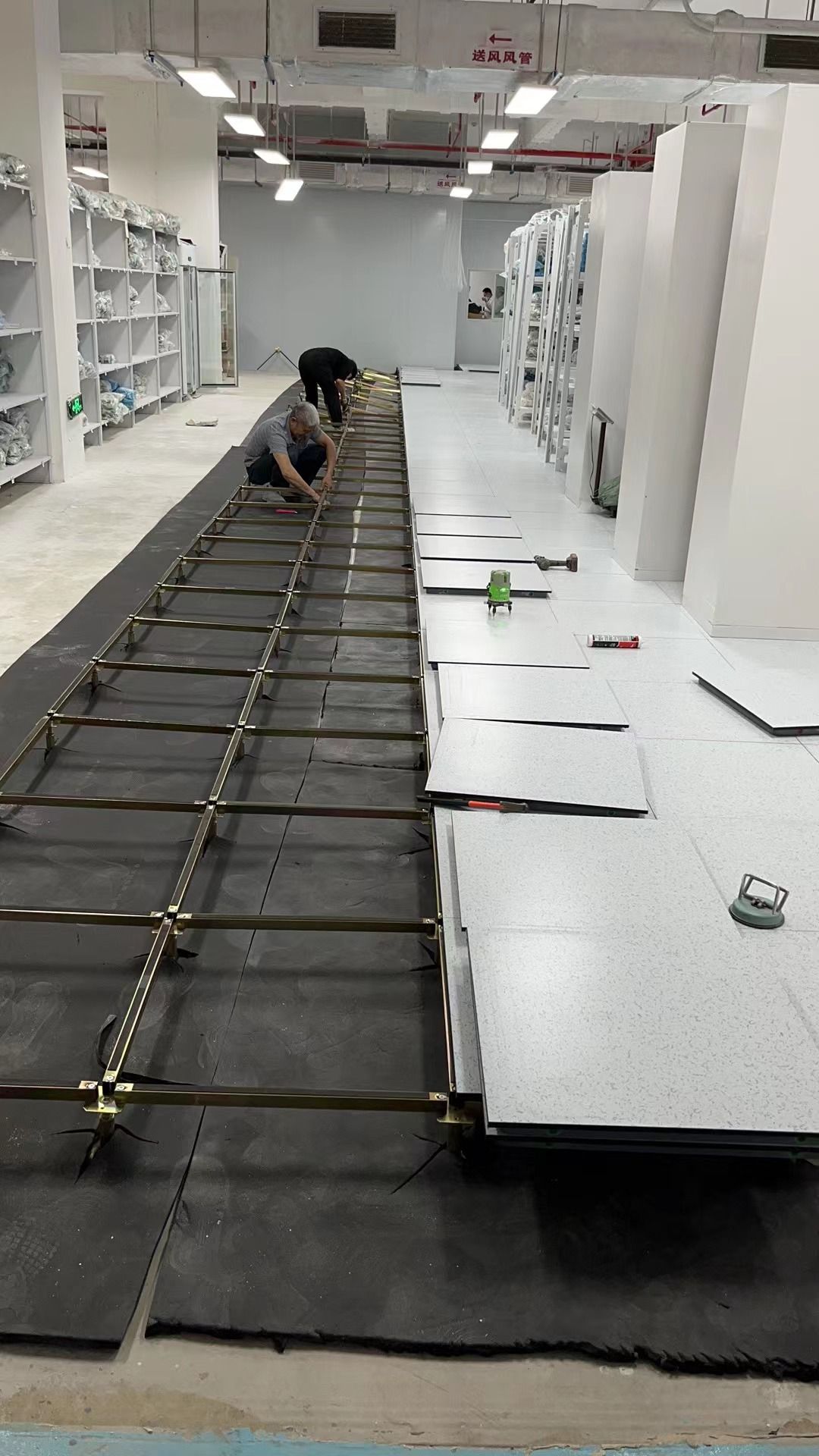
Rooms dependent on this floor’s performance typically rely on raised access panels with precise grounding paths and calibrated air-leakage rates. Underfloor plenums become active cooling channels, while panel coatings dissipate static before it reaches sensitive circuits. Even slight variations in panel height or edge support can create vibration points that affect optical alignment tools and high-speed pick-and-place machines. That is why specifications here are treated less like construction details and more like operational parameters, checked against actual load patterns, thermal output, and future equipment upgrades before a single tile is locked into place.
FAQ
It’s a raised access floor panel built around a welded steel shell, topped with a high-density ceramic tile. The ceramic layer provides a hard, easy-to-clean surface, while the steel base gives the panel its structural strength. Antistatic performance comes from conductive materials embedded through the ceramic and the edge trim, so any static charge drains to the grounding grid instead of accumulating on the surface.
Vinyl and laminate are cheaper at first, but they scratch and wear quickly under rolling loads or heavy foot traffic. Ceramic holds up much better without losing its conductive properties. It’s also non-porous, so spilled solvents, acids, or cleaning agents won’t soak in and cause the surface to peel or bubble. That makes it a longer-lasting choice for demanding environments.
Think of any room where static discharge can damage sensitive electronics or ignite flammable materials. Server rooms, semiconductor cleanrooms, hospital operating theaters, and control centers for utilities or transportation are all typical sites. The ceramic surface is especially useful where the area needs frequent cleaning or where chemical resistance matters.
Unlike floors that rely on a sprayed-on antistatic coating, the ceramic tile here has conductive particles distributed through its full thickness. As the surface wears, it continues to conduct. You still need to connect the installed grid to a proper grounding point, but the panel resistance remains stable for decades as long as the subfloor stays clean and dry.
Many standard raised floors use a particleboard or calcium sulfate core, which can sag or swell if moisture gets in. All-steel panels have a welded steel bottom and edges, usually filled with lightweight cement for additional rigidity. That construction means tighter seams, better load distribution, and almost no warping over time, so heavier equipment can move across them without tiles shifting.
Ask for the panel’s rated concentrated load and uniform load in kilonewtons instead of a vague ‘heavy duty’ label. Check whether the ceramic is through-body conductive rather than just glazed on top, and request a sample so you can measure surface resistance with a resistivity meter. Also confirm the factory includes edge trim and grounding hardware that match your spec, and clarify if the quote covers export packing and palletizing since steel panels are heavy.
Yes, if you select the right load grade. Most factories offer panels rated from roughly 300 kg concentrated load for lighter use up to 600 kg or more for heavy racks. The ceramic face typically has a high abrasion rating like PEI IV or V, so caster wheels won’t leave grooves. Make sure the understructure stringers and pedestals match the panel rating, otherwise the weakest point will be the support, not the tile itself.
It’s generally not as slippery as polished porcelain because the surface is matte or lightly textured for antistatic environments. Daily maintenance only needs a damp mop or antistatic cleaner to keep the surface conductive. Avoid wax, oil-based cleaners, or sealants that leave an insulating film, and the tight panel joints will prevent dirt and spills from settling into gaps.
Conclusion
All-steel ceramic antistatic floors hold up far better than standard options because the steel core resists impact and load stress, while the ceramic surface prevents premature wear that often breaks the conductive path in vinyl or laminate tiles. The ceramic layer isn't just there for looks—it provides a durable, low-resistance contact point that allows static charges to bleed off gradually into the grounded steel beneath, instead of building up and discharging through sensitive components. When sourcing from Chinese manufacturers, pay close attention to the consistency of the ceramic thickness, the flatness of the steel pan, and the quality of the conductive adhesive between layers. Cheap fillers or uneven glazes can create dead spots where resistance spikes, undermining the whole floor's rated performance.
Even a well-made floor will fail if installation shortcuts are taken. Loose pedestals, missing stringers, or gaps at the perimeter break the grounding path, and using ordinary screws or wiping down the subfloor with non-conductive cleaners can isolate the panels from the earth connection. Maintenance also matters: antistatic floors keep their conductive path only if you avoid waxes, oils, or polymer coatings that insulate the surface, and if you routinely check that grounding copper strips remain firmly connected. These floors are often the only practical choice in server rooms, semiconductor cleanrooms, and medical imaging suites where a single uncontrolled discharge can damage equipment or corrupt data. In those environments, the combination of a truly conductive ceramic wear layer and an all-steel support structure provides both the mechanical stability and the predictable electrical resistance that standard antistatic coverings rarely sustain over years of service.
Contact Us
Contact Person: yuki
Email: [email protected]
Tel/WhatsApp: +86 18664390732
Website: https://www.lipinfloor.com/