

China RCBO Essential Guide to Residual Current Breaker with Overcurrent Protection
2026-08-22
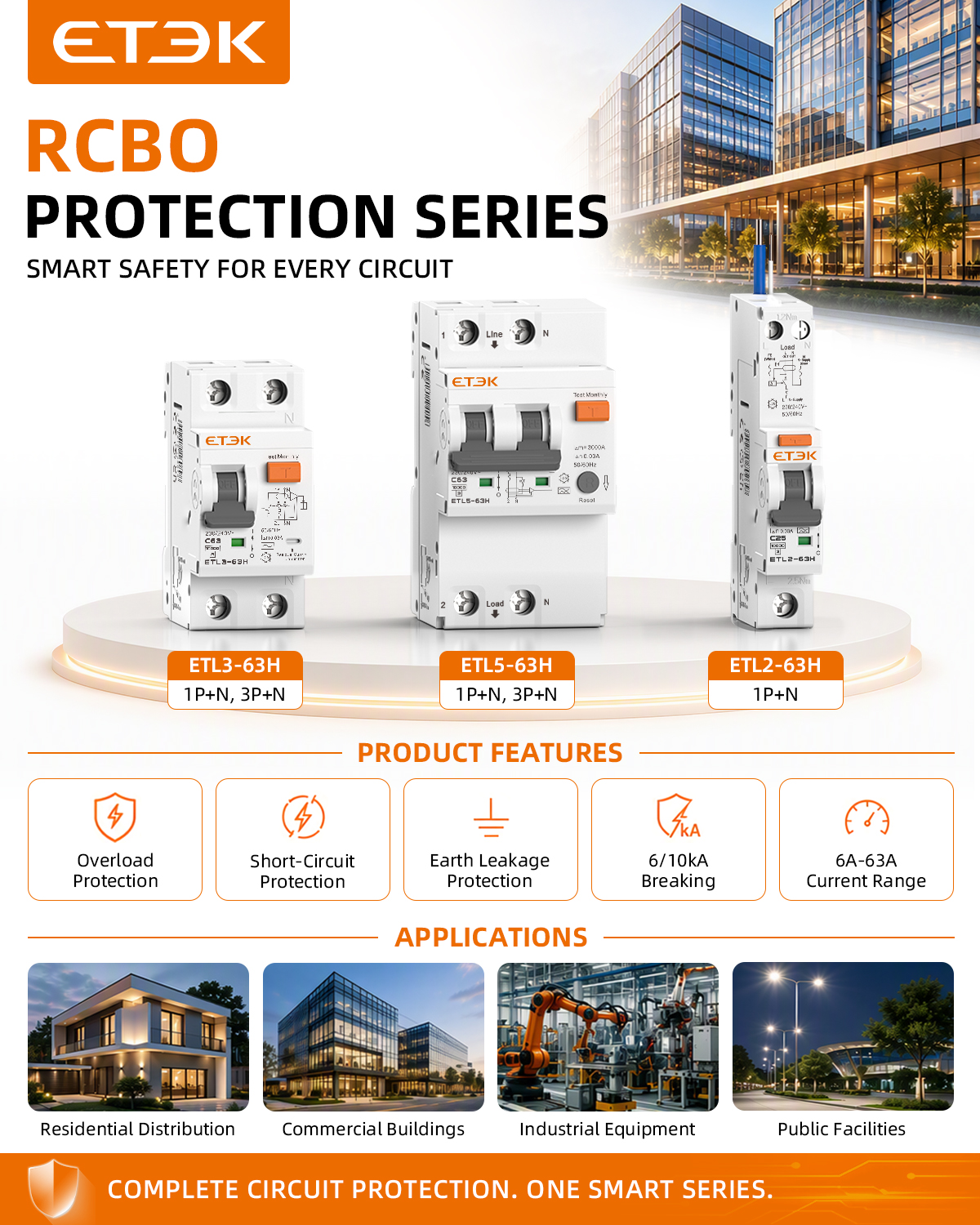
Every electrical installation has a silent guardian—one that steps in before a fault turns into a disaster. In China, the Residual Current Breaker with Overcurrent Protection (RCBO) is that unsung hero, combining leakage protection and overload defense in a single compact unit. But how much do you really know about selecting and installing one? This guide cuts through the jargon to give you the essentials, backed by practical insight from ETEK, a name trusted in low-voltage electrical components. Whether you're an electrician or a curious homeowner, what you learn here just might change how you think about circuit safety.
Why China’s Voltage Environment Demands More from an RCBO
China’s grid spans a vast, unevenly loaded network where nominal 220 V can swing well outside stable European tolerances. In older residential compounds and industrial districts, voltage routinely dips below 180 V during peak load or climbs past 260 V at night. A conventional RCBO tuned for a narrow input window may misinterpret residual current or hesitate to trip under such swings, leaving downstream wiring and equipment dangerously exposed.
Harmonic pollution adds another layer of stress. Variable frequency drives, EV charging piles, and mass adoption of LED lighting distort the current waveform throughout commercial and residential feeders. These harmonics heat internal components, blunt the accuracy of leakage detection, and can trigger nuisance tripping or—more dangerously—delay a real fault response. The RCBO must reject noise without dulling its sensitivity to an actual earth leakage.
Lightning-prone overhead lines and frequent switching transients across China’s distribution network deliver sharp voltage spikes that punish weak contacts and insulation. An RCBO built only for clean lab conditions may suffer welded contacts, a fried trip coil, or a silent failure after a nearby strike. Field-grade impulse withstand voltage, robust arc quenching, and wide-range power supply tolerance are not optional extras here; they are the difference between protection and a false sense of safety.
Reading the GB Codes: What Your Supplier Won’t Tell You
Most buyers treat GB codes as a stamp of quality, but your supplier is counting on you not knowing how to read them. The first digit after “GB” tells you whether the standard is mandatory or recommended, and that distinction alone can shift your entire sourcing decision. If you’re importing something with a voluntary code attached, your supplier might be using it to imply safety testing that was never actually required.
Suppliers rarely volunteer how old the referenced GB version is. A product can still carry a valid-looking code while referencing a standard from a decade ago, long before newer material restrictions or testing methods were introduced. Ask for the full code with the year, then check it against the latest published version yourself. That extra step is where many hidden cost and compliance risks hide.
What your supplier won’t mention is that GB codes often cover only a narrow part of a product’s construction. A cable might meet the GB standard for its outer sheath but not for the conductor or connector materials. Reading the exact scope of the code, not just the headline number, reveals whether the certification actually covers the parts that fail first.
Picking the Right Breaking Capacity for Older Chinese Wiring
When dealing with older Chinese residential or light commercial wiring, the actual available fault current at the end of a long run can be surprisingly low due to oxidized joints, undersized aluminum conductors, and the impedance of old steel conduit. This leads some electricians to install miniature circuit breakers with only 4.5 kA or 6 kA breaking capacity, assuming the aging network will limit the short-circuit current. That assumption holds for a distant outlet on a 1.5 mm² line, but fails near the main distribution board or in a building fed by a large transformer. A quick loop impedance test or a conservative estimate from the transformer kVA and cable length is far more reliable than guessing based on cable age.
Many older Chinese installations still use DZ47-style breakers rated at 6 kA or 10 kA Icn, and replacing them with the same rating often seems like the easy fix. However, the run breaking capacity (Ics) and the voltage rating matter just as much as the headline number. Where a building has been rewired partially with new feeders but old branch circuits remain, the available fault current at the panel can rise significantly. Selecting a 10 kA device for a small apartment may sound overspecified until you check the upstream transformer and the short feeder run to the first distribution box. It is cheaper to standardize on 10 kA for main incoming breakers and reserve the lower ratings for final circuits well away from the source.
For old concrete-and-brick housing with no dedicated PE conductor or with degraded earthing, the fault current in a line-to-earth fault can be too low to trip a standard MCB quickly, but that does not mean you can ignore the phase-to-phase or phase-to-neutral breaking capacity. The breaker still has to interrupt a bolted fault between live conductors. Where the original wiring is suspect, combine an adequate breaking capacity with RCD protection and verify the maximum prospective short-circuit current at the point of installation before finalizing the breaker choice. This avoids both the expensive habit of over-speccing every circuit and the dangerous habit of assuming old wires always protect themselves.
Installation Pitfalls That Trip Up Even Licensed Electricians
One of the sneakiest mistakes happens in subpanels, where even experienced electricians sometimes bond the neutral and ground buses together. Code only allows that connection at the main service disconnect. When you tie them together downstream, normal return current starts flowing on the grounding conductors, which can energize metal enclosures and create a shock hazard that doesn’t show up until someone touches a fridge and a stove at the same time. It’s the kind of thing that passes a quick visual inspection but fails the moment a fault occurs or a ground rod loses its connection.
Wire sizing gets plenty of attention on paper, but real-world installations trip people up with voltage drop and terminal temperature ratings. You might pick a conductor that meets the ampacity table, yet on a long run to a detached garage or a well pump, the voltage sag under load causes motors to run hot and lights to flicker. And using 90°C rated wire doesn’t mean you can push it to that limit if the breakers and lugs are only rated for 75°C—ignoring that mismatch is a common cause of nuisance tripping and burned terminations. On older homes, reusing existing aluminum branch circuits without proper anti-oxidant paste and torque settings just invites callbacks years later.
Overstuffed junction boxes rarely get flagged until the drywall is up and the inspector starts counting wires. Box fill calculations feel like a chore, but cramming too many conductors into a small enclosure reduces heat dissipation, makes pulling new wire nearly impossible, and increases the chance of nicked insulation from sharp edges. Another overlooked item is the expanding requirement for AFCI and GFCI protection on older circuits. An electrician might extend a bedroom circuit or add a bathroom receptacle without updating the breaker, only to have the final inspection fail and force an expensive rework that eats the profit on the whole job.
The Real Difference Between Type AC, A, and B RCBOs in China
Walking through any electrical wholesale market in Guangzhou or browsing supplier catalogs from Wenzhou, you’ll quickly notice that RCBOs aren’t just differentiated by brand or current rating. The letters AC, A, and B stamped on the side often get treated as interchangeable by buyers chasing the lowest price, but that assumption can leave a residential or light commercial installation dangerously underprotected. In China’s rapidly evolving low-voltage landscape, where a single building might mix old inductive loads with modern inverter-driven appliances, the choice between these three types determines whether residual current protection actually trips when it should—or stays silent until insulation failure turns into a fire.
Type AC remains the legacy workhorse across many older Chinese apartments and rural distribution boards. It responds only to pure sinusoidal residual currents, which made sense when loads were mostly resistive heaters, incandescent lighting, and simple motor circuits without electronic speed control. But the moment you introduce a washing machine with a variable frequency drive, an LED lighting array, or a split-type air conditioner with DC inverter technology, the residual fault current contains a significant DC component or high-frequency harmonics that a Type AC unit simply cannot detect. That means a real leakage path can develop on the load side while the RCBO sits there looking healthy—no trip, no warning. For contractors still installing Type AC in new builds to save a few yuan per pole, the cost of one undetected fault far outweighs the savings on the bill of materials.
Type A closes much of that gap by adding sensitivity to pulsating DC residual currents, which are exactly what single-phase rectifiers and basic switch-mode power supplies produce when they fail. In nearly every modern Chinese household, at least one circuit feeds electronics—phone chargers, computer power supplies, LED drivers—so Type A has become the de facto minimum for new residential construction in many provincial design codes. Type B goes further still, handling smooth DC residual currents and multi-frequency faults that appear in three-phase EV chargers, elevator drives, solar inverters, and medical equipment. The physical difference isn’t just firmware: Type B units typically include a second detection core or a fluxgate sensor to measure DC directly, which adds size and cost. For most domestic circuits, Type A is the practical sweet spot; Type B belongs only where the equipment list explicitly demands it, such as a parking garage with EV charging stations. Ignoring these distinctions and treating AC, A, and B as interchangeable leaves a project technically compliant on paper but functionally blind to the actual fault spectrum present in the building.
Cost vs. Longevity: How Cheap RCBOs Fail in Humid Climates
In coastal or tropical regions, moisture doesn't just sit in the air—it creeps into every enclosure, terminal, and PCB trace. Cheaper RCBOs often skip the conformal coating or use a thin, uneven layer that breaks down within months. Once humidity reaches the sensing coil or the trip mechanism, calibration drifts and nuisance tripping becomes a daily nuisance. Eventually, the device either fails to trip when needed or stays permanently open, leaving circuits unprotected.
The real cost shows up in the maintenance log. A budget RCBO that barely survives one monsoon season may need replacing two or three times over the lifespan of a mid-range unit built with tropicalized internals and sealed adjustment pots. Factor in the labour for repeated call-outs, the downtime for commercial loads, and the risk of a silent failure during a ground fault, and the initial savings disappear quickly. In humid environments, longevity isn't a luxury—it's the main safety feature.
FAQ
An RCBO combines residual current detection and overcurrent protection in one modular device. It monitors the live and neutral conductors for imbalance—typically 30mA or less—and trips when leakage current suggests a person may be touching a live part. At the same time, its thermal-magnetic or electronic trip unit reacts to overloads and short circuits, so a single unit protects a circuit from both earth faults and excessive current.
Chinese manufacturers have scaled up production with automated assembly lines and in-house component stamping, which lowers cost without automatically sacrificing build quality. Many factories now hold international certifications like CB, CE, UKCA, or regional marks, and they offer flexible OEM branding, compact 18mm-wide designs, and large batch consistency. The real difference lies in selecting a factory that shows third-party test reports rather than relying on price alone.
Look for IEC 61009-1 as the core product standard for RCBOs. Depending on the target market, additional approvals may include EN 61009-1 for Europe, BS EN 61009-1 for the UK, AS/NZS 61009.1 for Australia/New Zealand, or CCC for domestic Chinese use. CB scheme test certificates are useful for multi-country acceptance. Avoid units that only claim "CE" without supporting documentation, as self-declaration alone does not prove third-party testing.
Match the rated current to the circuit's design load and cable size—common values are 6A, 10A, 16A, 20A, 25A, 32A, and 40A. For personal protection, a 30mA residual current sensitivity is standard for socket outlets and wet areas. For equipment protection only, 100mA or 300mA may be used. Also check the tripping curve: type B, C, or D depending on inrush currents, and verify the short-circuit capacity, typically 6kA or 10kA, against the installation's prospective fault current.
The most common problems are busbar compatibility, neutral conductor termination, and torque settings. Some RCBOs are designed for pin-type busbars while others suit fork or cable connections only, so confirm the terminal type before ordering. The functional earth or neutral lead—often a white or blue pigtail on electronic RCBOs—must be connected correctly or the device may fail self-test. Also use a calibrated torque screwdriver because under-tightening leads to overheating and over-tightening can crack the housing.
Press the test button every six months, but treat it as a basic functional check rather than a full residual current test. The button creates an internal imbalance and should trip the device immediately; if it does not, disconnect the circuit and replace the unit. For more reliable verification, use an RCD tester to inject a controlled leakage current and measure the tripping time. A healthy RCBO should trip within 40ms at 5 times its rated residual current, and within 300ms at the rated residual current for general-purpose devices.
A well-built RCBO can handle around 10,000 mechanical operations and several thousand electrical operations at full load, though electronic types may have component aging that shortens practical life to 10 to 15 years. Replace a unit after any major short circuit event, if the test button becomes unreliable, if thermal damage or discoloration appears, or if insulation resistance testing indicates internal leakage. Regular field testing combined with visual inspection gives a better replacement trigger than a fixed calendar age.
Conclusion
China’s grid is rarely a polite 220V—rural lines swing between 190V and 250V, and three-phase imbalances can push neutral currents through protective devices in ways textbook installations never anticipate. That alone makes a generic RCBO a gamble. The GB codes on the side of the unit aren’t decoration: GB/T 16917.1 and GB/T 22794 mark different test regimes, and plenty of suppliers quietly ship units certified only for steady-state conditions. For older apartment blocks with 2.5mm² aluminum or aging copper, a 6kA breaking capacity can be borderline; the impedance of corroded joints and decades of spliced neutrals often calls for 10kA if you want the breaker to interrupt a real fault rather than arc internally.
Installation errors persist even among licensed electricians—swapping incoming and outgoing terminals, or ignoring the functional earth lead on electronic RCBOs, which defeats the trip mechanism during a lost neutral. Then there’s the type choice. Type AC units are almost useless on modern Chinese appliances with switching power supplies and variable-frequency motors; Type A handles pulsating DC leakage, while Type B is needed for EV chargers and some inverter air conditioners. In humid coastal provinces like Guangdong and Fujian, cheap RCBOs fail not from sudden overload but from condensation and corrosion inside the test circuit and trip coil. Paying for a sealed, tropicalized unit usually outlasts two or three budget replacements, especially where salt air and monsoon humidity sit inside distribution boxes for months.
Contact Us
Contact Person: Andy
Email: [email protected]
Tel/WhatsApp: +86 13356133008
Website: https://www.etek-china.com/