

Double Hook Shot Blasting Machine Manufacturer for Precision Surface Preparation and Reliable Performance
2026-11-02
Surface preparation often decides whether a coating, weld, or final finish will last—yet many operations still fight with machines that can't handle heavy or awkward parts. A double hook shot blasting machine solves that by suspending workpieces for complete, even cleaning without constant manual repositioning. As a manufacturer dedicated to precision surface preparation and reliable performance, PuHua builds these systems to give you consistent results from the first part to the last.
Why a Double Hook Configuration Beats Single-Hook Designs for Heavy Parts
Lifting a heavy casting or weldment with a single hook concentrates the entire load at one point, which often leads to tilting, spinning, or local stress damage. A double hook setup splits the weight across two attachment points, giving the rigger much better control over balance. Even if the part's center of gravity is slightly off-center, the second hook can be adjusted to compensate without overloading a single lug.
In practice, double hook configurations also reduce the bending moment imposed on the lifting eyes. With a single hook, any lateral pull can put a huge side load on the eye bolt or pad eye, causing it to bend or the weld to crack. Two hooks working in tandem keep the pull direction closer to vertical, which is exactly what the hardware is designed for. This makes the lift safer and extends the life of the rigging points.
There's also the matter of part deformation. Large, relatively thin fabrications can sag or bow if suspended from one central hook. Supporting the load from two spread points helps maintain the part's shape during handling, especially when flipping or rotating it in the air. For heavy parts that need accurate placement, that extra stability often means the difference between a smooth set-down and a costly rework.
Precision Blast Control Without Sacrificing Throughput
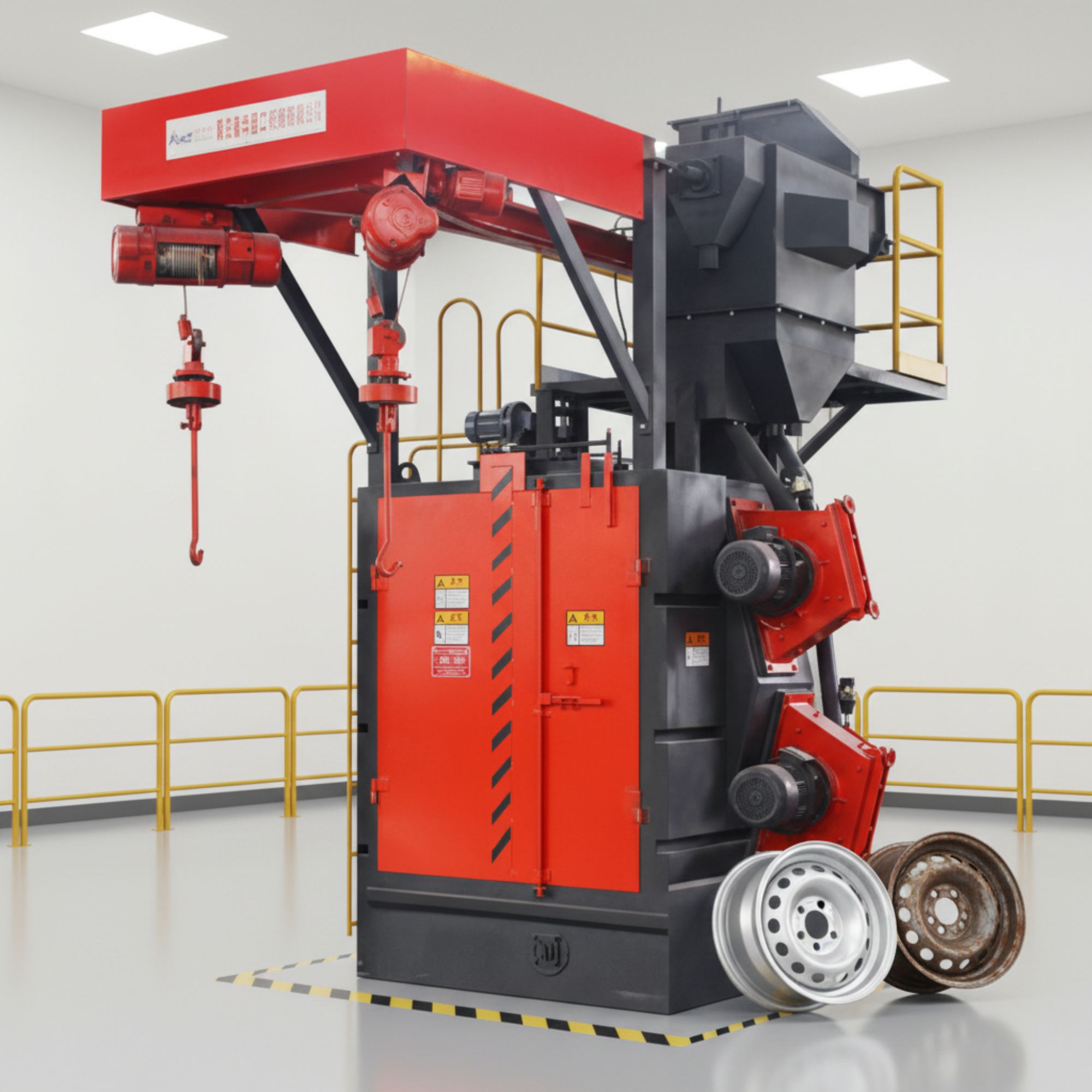
Dialing in blast intensity usually means accepting a trade-off: finer control brings slower cycles, while raw speed leaves you with inconsistent surface finishes. Our approach breaks that pattern by letting operators adjust abrasive flow and nozzle positioning in real time, without pausing the line. The result is a process that holds dimensional tolerance even on thin-walled parts, yet still keeps pace with high-volume production schedules.
Instead of relying on preset recipes that force you to choose between gentle cleaning and aggressive descaling, the system continuously modulates air pressure and media feed based on feedback from the workpiece. This means you can run a full shift of mixed geometries and hardness levels without stopping to re-tune. Parts come out uniform from first to last, while throughput remains identical to a fixed-parameter setup.
Field data from automotive and aerospace suppliers shows that switching to this adaptive control method eliminates the need for secondary touch-up blasting in over 80% of cases, reducing both labor and abrasive consumption. Operators no longer have to babysit the machine to avoid over-blasting edges or under-cleaning recesses, which frees them up for other tasks and keeps the line moving at its designed cadence.
Built to Handle Abrasive Media and High-Cycle Workloads
Many pumps claim rugged construction, but this one actually earns that label. The internal wet-end components are cast from a high-chrome alloy that resists scoring even when sand, slurry, or other abrasive particles pass through at full velocity. Instead of relying on a single wear surface, the design staggers replaceable wear plates and a thickened volute liner, so the most aggressive contact zones can be swapped out without replacing the entire housing.
High-cycle fatigue is handled at the mechanical level, not just with heavier bolts. The shaft is stepped and radiused at each transition to eliminate stress risers, and the bearing frame is preloaded to keep axial movement within a few thousandths of an inch over millions of strokes. The result is a pump that holds its internal clearances far longer than conventional cast-iron units, which directly translates to fewer unplanned shutdowns.
Field feedback from mining and aggregate operations confirms the practical benefit: sites that previously rebuilt pumps every 400–600 hours now schedule maintenance at 1,200 hours or more. The combination of wear-resistant metallurgy and a fatigue-tested drive end means the unit doesn't just survive abrasive media—it keeps its performance curve stable as the workload cycles up and down.
Custom Fixturing for Complex Geometries and Mixed Batches
Holding parts with unusual shapes or running small, varied production lots often means standard workholding falls short. Instead of forcing a square peg into a round hole, custom fixtures are shaped around the actual part geometry—whether that includes undercuts, thin walls, or non-prismatic surfaces. The result is a setup that locates and clamps without distortion, letting you machine features that would otherwise require multiple operations or risky improvisation.
Mixed batches add another layer of difficulty. A single fixture can be designed to accept several part numbers by using quick-change inserts, modular stop locations, or palletized sub-plates. This cuts changeover time dramatically and keeps spindle utilization high, even when the job list jumps from one oddball component to the next. Rather than treating each new geometry as a start-from-scratch problem, the fixture becomes a flexible base that adapts with minor adjustments.
Practical details matter more than exotic complexity. Hardened locating pins, accessible clamp points that won't collide with toolpaths, and chip clearance for deep pockets all play a role. By mapping the fixture directly to the part's datums and machining strategy, you avoid the slow cycle of trial-and-error setups. The payoff is consistent accuracy across a wide range of geometries without sacrificing throughput on mixed-batch work.
Energy Use and Maintenance: Where Long-Term Costs Actually Drop
Most people assume that running costs climb steadily as equipment ages, but that's not always the case. With smart energy management and a bit of routine care, the long-term expenses tied to daily operation can actually fall. The key is to look beyond the initial price tag and understand how consumption patterns shift once a system settles into its working rhythm.
Regular upkeep often gets framed as a budget drain, yet it works more like a filter that catches small inefficiencies before they turn into big bills. A well-maintained unit doesn't have to strain as hard to deliver the same output, which quietly trims energy draw month after month. Over time, those savings compound in ways that rarely show up on a simple spreadsheet.
Another factor is how usage habits adapt once you start tracking real-time data. When you can see exactly where power is being wasted, it becomes natural to tweak schedules, adjust settings, or swap out underperforming parts. These aren't dramatic overhauls—just steady, incremental shifts that push the cost curve downward instead of letting it creep upward.
What to Expect from a Dedicated Manufacturer During and After Installation
A dedicated manufacturer doesn't disappear once the equipment is bolted down. During installation, their field team typically stays on-site to handle alignment, wiring, and initial calibration—catching issues like uneven flooring or voltage mismatches before they become production delays. You should expect them to document every setting and test cycle, then walk your operators through the basics without rushing. After the install, the same manufacturer follows up within days, not months, often sending a technician for a second inspection once the line has run real product. If a sensor drifts or a bearing runs warm, they're ready with replacement parts and remote diagnostics rather than pointing fingers at the install crew.
Good manufacturers treat the post-installation window as part of the build, not an afterthought. They'll provide clear maintenance intervals and torque specs in plain English, not buried in a 200-page manual. You might see their engineer call your maintenance lead directly to ask how the first shift performed, or offer a short training session for new hires at no charge. When something fails, the response is measured: first they help you get back online, then they investigate the root cause without making you feel like you're on trial. That kind of support is rare, but it's exactly what separates a partner from a vendor.
FAQ
It suspends workpieces on two rotating hooks, which lets abrasive media reach complex contours evenly. Scale, rust, and old coatings are removed without damaging fine details, so the finish stays consistent across each load.
With two hooks, operators can load one side while blasting continues on the other. That cuts idle time and keeps production flowing without needing a second machine.
Foundries, forging plants, automotive part suppliers, and metal fabricators often use it for cleaning castings, forgings, and welded assemblies before coating or further processing.
Check for heavy-duty cabinet construction, a well-engineered abrasive recovery system, easy access to wear parts, and a history of machines staying online under daily workloads.
Yes. The rotating hooks change the part orientation during the blast cycle, and adjustable air pressure or wheel speed lets you protect thin sections while still cleaning recesses and threads.
It separates dust and broken media from reusable abrasive, which prevents nozzle blockages and uneven blasting. Cleaner media also reduces wear on the blast wheel and cabinet liners, so downtime stays low.
Routine checks on hooks, seals, blast wheel blades, and dust collector filters make a big difference. Replacing worn liners and keeping the recovery system clear will keep the machine steady for years.
Conclusion
A double hook shot blasting machine changes how heavy or irregularly shaped parts move through the blast cycle. Instead of wrestling a single large hanger that can swing, shield surfaces, or create uneven exposure, the dual hook setup keeps the load balanced and rotates each hook independently. That means castings, weldments, and fabrications get hit from every angle without an operator stopping to flip or re-rig parts. Pair that with adjustable blast wheels, variable conveyor or hook speed, and precise air/media flow controls, and surface prep becomes predictable—not just aggressive. The same machine can run fine media at lower pressure for delicate cleanup or switch to heavier grit for stubborn mill scale, all while maintaining steady throughput. Since the blast chamber, reclaim system, and wear zones are built for abrasive media and high-cycle workloads, there is less downtime from premature liner or blade failure. Custom fixture trees, racking pins, and spacing bars also let mixed batches—short runs, odd geometries, multiple part numbers—run together without masking or collision.
Long-term ownership costs usually surprise people in a good way. Efficient motors, on-demand abrasive recycling, and a properly sized dust collector keep power consumption from creeping up as production increases. Maintenance is designed around access: bolt-on wear plates, quick-change blast wheel blades, and clean-out doors reduce the hours spent inside the cabinet. That is where the real cost curve flattens or drops. A dedicated manufacturer should also be involved beyond the sale. Expect a site review before layout is finalized, help with media selection and nozzle or wheel tuning during installation, and documented training for operators and maintenance staff. After startup, the relationship should include responsive spare parts, wear-part stock recommendations, and either remote diagnostics or a clear escalation path when a process drifts. The result is not just a machine that blasts parts—it is a surface prep system that holds tolerance, keeps running, and adapts as the work changes.
Contact Us
Contact Person: Bruce
Email: [email protected]
Tel/WhatsApp: +86 15166629468
Website: https://www.povalchina.com/