

OEM Spring Energized PTFE Seals: A Complete Guide to High-Performance Sealing
2026-11-02
When standard seals fail under extreme pressure, temperature swings, or aggressive chemicals, OEM spring energized PTFE seals step in as the quiet workhorses of modern industry. But not all seals are created equal—design nuances, spring selection, and material purity separate a reliable seal from a costly leak. In this complete guide, we strip away the marketing fluff and break down exactly how these high-performance seals work, where they excel, and what to look for in a supplier. Whether you're an engineer specifying for a new project or troubleshooting a recurring failure, understanding the core principles will save you time and downtime. At TAIFNO, we've spent years refining the production of custom PTFE spring energized seals for demanding OEM applications, and this guide draws on that hands-on experience to give you practical, no-nonsense insight.
The Hidden Engineering Behind OEM Spring Energized PTFE Seals
The real work in an OEM spring energized PTFE seal starts long before installation. The spring is not merely a backup ring; it is chosen to deliver a deliberate force curve. Depending on the gland and media, an engineer may specify a cantilever spring for a flat load profile over a wide deflection range, or a canted coil spring when they need high unit loading in a compact cross-section. That spring must keep radial contact stress within a narrow band: enough to follow shaft runout and lip wear, not so much that the PTFE jacket extrudes or generates excessive friction. On the polymer side, PTFE is rarely used neat. Fillers such as glass fiber, carbon, graphite, or MoS2 are blended in specific ratios to shift wear rate, creep resistance, and thermal conductivity. These filler packages are matched to the spring force and running surface hardness, which is why two seals can look identical yet behave very differently in the same housing.
Lip geometry is another place where invisible decisions accumulate. The included angle of the sealing lip, the width of the contact band, the back-bevel that allows assembly without rolling, and the heel radius where the jacket wraps the spring all interact. A steeper lip angle increases contact pressure per unit of spring force but shortens break-in tolerance; a wider contact band spreads load and reduces leakage on rough surfaces but raises torque. OEMs often use FEA to map how the jacket deforms under system pressure, temperature soak, and eccentric motion. The goal is not maximum tightness but a stable contact patch that survives start-stop cycles without flipping or forming a leakage path at the heel.
Manufacturing control is the third hidden layer. Spring coil pitch, weld consistency, and free length are held to tolerances that are often invisible on a general arrangement drawing. The PTFE jacket is machined from molded blanks with controlled crystallinity and then post-cured or stress-relieved so it does not relax during hot commissioning. Some OEMs also require vacuum testing or helium leak verification of the assembled seal before it leaves the supplier, because a seal that looks right on a coordinate measuring machine can still leak if the spring is slightly misaligned in the groove. This co-engineering between hardware OEM and seal manufacturer is where service life is actually bought or lost.
Getting the Right Spring Force and Jacket Profile for Your Process
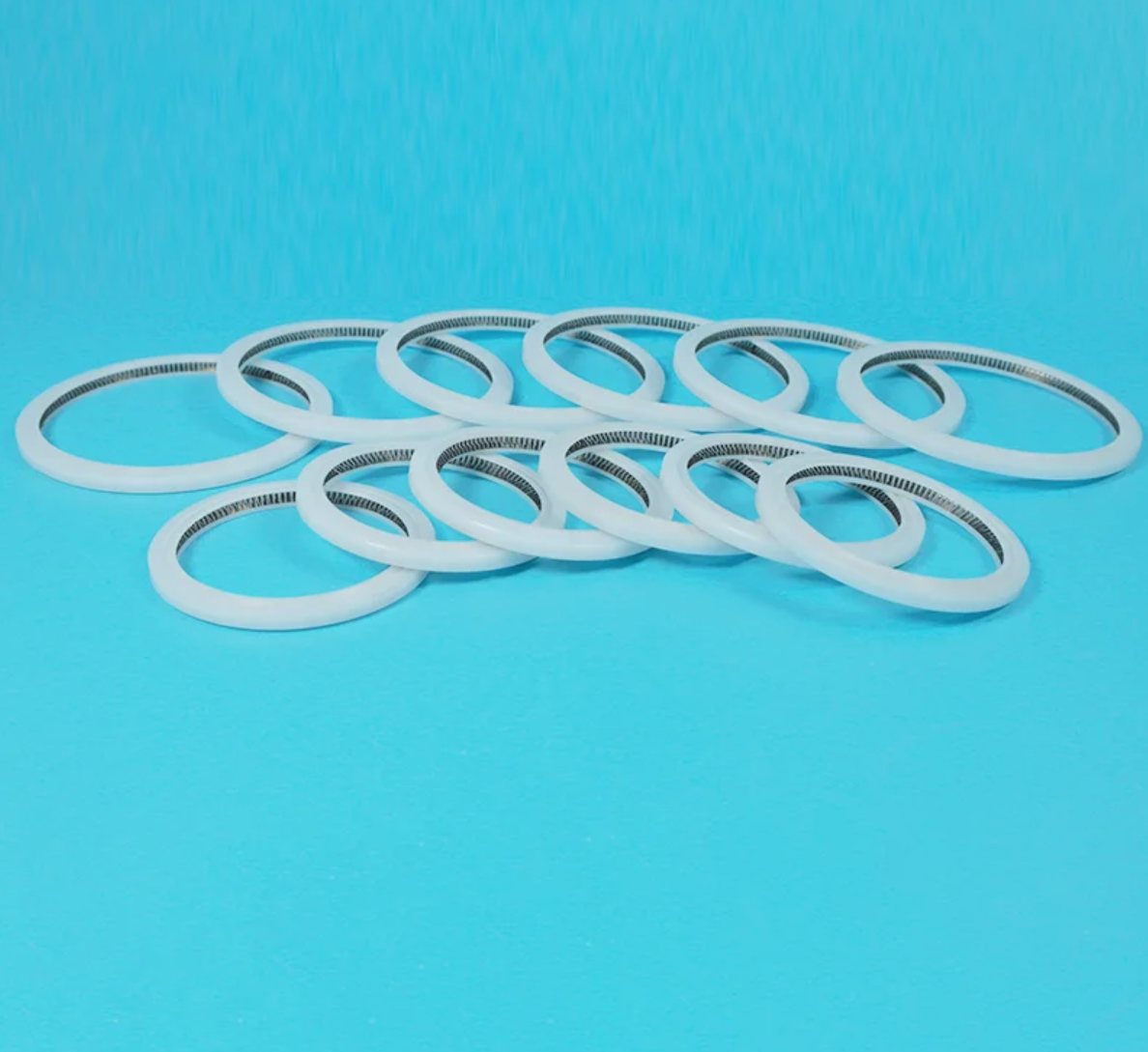
Spring force isn't a one-size-fits-all number. It hinges on the seal's duty: a dynamic rod seal needs enough lip load to wipe the film thin without dragging, while a static face seal might demand higher unit loading to combat creep and cold-flow. Overlook this and you'll chase leaks that tightening bolts can't fix.
The jacket profile is where geometry meets reality. A sharp lip edge cuts through viscous films but wears faster; a rounded or beveled lip lasts longer yet allows thicker lubrication layers. Match that profile to shaft speed, surface finish, and media viscosity, or the best spring in the world becomes a decoration.
Testing beats guessing. Pull a few candidate springs and profiles through a short bench trial with your actual process fluid and temperature swings. Measure breakout friction, running torque, and weepage after each cycle. That hour of data will save you from a year of field failures.
How These Seals Handle Thermal Shock and Aggressive Fluids
Thermal shock hits hardest at the sealing lip, where a sudden drop from process temperature to ambient can create hairline cracks in less flexible materials. These seals are compounded from perfluoroelastomer or silicone blends that keep elongation above 200% from -40°F to 500°F. A dual-hardness cross-section puts a softer, more elastic core under a thin chemical-resistant jacket, so the outer layer absorbs chemical attack while the inner core damps the mechanical stress of expansion and contraction.
Against aggressive fluids, the jacket is formulated with a high fluorine-to-carbon ratio, resisting swelling in ketones, esters, and concentrated acids. Instead of relying on a single material, the design uses a staggered labyrinth geometry that reduces the fluid contact area at the dynamic interface. The seal body is post-cured in a two-stage cycle that drives out volatile fractions, minimizing outgassing and preventing micro-void formation when temperatures cycle rapidly while acids or solvents are present.
Installation Pitfalls That Shorten Seal Life More Than Wear
A seal that fails within days of installation rarely dies from old age. The real culprit is often a rushed or careless install—something as simple as forcing the seal over a sharp shaft shoulder without proper protection can leave microscopic cuts that widen under pressure. Likewise, pressing a seal into a bore with a misaligned driver or using a hammer directly on the seal face creates uneven stress that distorts the lip. These flaws may not be visible at first, but they set the stage for premature leakage long before normal wear would ever take its toll.
Another common mistake is ignoring cleanliness during assembly. Dirt, metal shavings, or even fibers from a rag can embed in the sealing lip and act like sandpaper once the system starts moving. Over-lubricating with the wrong grease is equally risky—some lubricants cause elastomers to swell or soften, reducing the seal's ability to hold its shape. In contrast to gradual wear, which gives predictable service intervals, installation errors produce sudden and erratic failures that are harder to diagnose and far more expensive to fix.
Choosing Between Spring Energized PTFE, Filled PTFE, and PEEK
The choice rarely comes down to a single property. Spring energized PTFE offers the widest chemical compatibility and excellent low-friction performance, especially in cryogenic or high-purity applications where the metal spring maintains lip pressure as the polymer wears or thermally cycles. That makes it a go-to for dynamic seals in aggressive media, but it can be soft under heavy loads unless paired with a robust backup ring.
Filled PTFE steps in when pure PTFE's tendency to creep or extrude becomes a problem. Glass, carbon, graphite, or polymer fillers improve compressive strength, thermal conductivity, and wear resistance, but they often sacrifice some chemical inertness and can scratch softer mating surfaces. You would pick a filled grade for static or slow rotary service where dimensional stability matters more than broad chemical exposure.
PEEK earns its place when temperature and mechanical load climb beyond what any PTFE-based material can handle. It retains stiffness and creep resistance above 250°C, handles high pressure without extrusion, and can be machined to tight tolerances. However, PEEK is less forgiving as a dynamic seal lip, demands harder mating surfaces, and its chemical resistance, while strong, does not match PTFE's near-universal inertness. The practical decision usually starts with the chemical and thermal envelope, then narrows by load, speed, and whether the application can tolerate a harder, less conformable sealing element.
Reading the Early Warning Signs of Seal Degradation
Most seal failures don't happen overnight. The first clues often show up as subtle changes in texture, color, or surface finish. You might notice the material feels harder or less flexible than it used to, or small cracks begin to form around high-flex areas. A dull, chalky appearance can signal that plasticizers are leaching out, leaving the seal brittle and prone to tearing.
Leakage, even if intermittent, is another sign worth taking seriously. A seal that weeps fluid during pressure cycles or leaves a thin film on the shaft is telling you the lip has lost its conformability. In dynamic applications, listen for changes in friction—squeaking, stick-slip motion, or an unexpected temperature rise at the sealing interface often precede visible failure by days or weeks.
Keep a close eye on the operating environment too. If the seal sees more heat, aggressive chemicals, or abrasive particles than originally specified, degradation accelerates. Regular inspection under good lighting, combined with a quick hardness check or a simple visual comparison against a new seal, can reveal early wear patterns before they turn into costly downtime.
FAQ
OEM spring energized PTFE seals combine a chemically resistant PTFE jacket with a corrosion-resistant spring that maintains constant radial load. They are designed to perform in harsh environments where conventional elastomer seals degrade, making them critical for aerospace, chemical processing, and medical equipment.
The spring provides continuous outward force on the seal lips, compensating for wear, pressure fluctuations, and thermal expansion. Unlike a static PTFE seal that can lose contact over time, the energized design actively maintains a tight seal even at low pressure or under vacuum.
Spring energized PTFE seals excel in extreme temperatures from cryogenic to over 260°C, in aggressive chemical media, and under high-speed dynamic motion. They also handle pressures from vacuum to very high levels without extrusion, where rubber seals would swell, crack, or require excessive lubrication.
Key factors include gland dimensions, surface finish, operating temperature range, media compatibility, pressure profile, and dynamic speed. The spring type—cantilever, helical, or canted coil—must match the application's load and friction requirements, and the PTFE compound may need fillers like carbon or glass for specific wear or friction characteristics.
Yes, unfilled PTFE offers the broadest chemical compatibility and lowest friction, while filled grades such as carbon-filled, glass-filled, or polymer-filled PTFE improve wear resistance and thermal conductivity. For high-pressure dynamic applications, a bronze-filled PTFE might be chosen, but it sacrifices some chemical inertness, so the selection always depends on the dominant failure mode.
Installation requires clean, burr-free hardware and proper tooling to avoid twisting or nicking the PTFE jacket. The seal must be evenly seated in the groove without excessive stretch, and for dynamic applications, a light lubrication may be needed initially unless the media itself provides lubrication. Skipping these steps leads to premature lip damage or leakage.
OEM designs are tailored to the exact groove geometry, motion profile, and media conditions of a specific equipment platform. This allows optimization of lip geometry, spring load, and material pairing to reduce friction, increase cycle life, or meet strict clean-room requirements—advantages that off-the-shelf seals rarely provide.
Conclusion
The real story behind OEM spring energized PTFE seals is not the polymer alone, but how the spring force and jacket cross-section are tuned to a specific process. A canted coil or V-spring does more than press the lip against the hardware; it absorbs cold flow and gland expansion while keeping a controlled leak path. Get that balance wrong and the seal either wipes too hard and generates heat, or rides too light and weeps at low pressure. Thermal shock makes this worse because PTFE expands and contracts at a different rate than most metals, so the energizer has to track the lip without losing contact. Aggressive fluids add another layer: the jacket material and fill package must resist chemical attack while the spring stays isolated from the process media. Over time, the first hints of trouble are often extrusion at the heel, erosion of the jacket, or a drop in spring energy that shows up as intermittent leakage after temperature swings.
Installing these seals demands more attention than the wear itself. A twisted energizer, a gland with too much clearance, or a sharp lead-in chamfer can cut life by half before the system ever sees full pressure. Comparing material options is not about picking the “best” one but matching the failure mode: virgin PTFE offers the widest chemical compatibility but poor wear and creep resistance; filled PTFE balances friction, wear, and extrusion; PEEK suits high temperature and high load but sacrifices conformity on rough surfaces. Reading early warning signs—surface scoring, asymmetric lip wear, reduced spring force after disassembly—lets maintenance teams schedule replacement before a leak shuts down a line. That kind of practical, failure-driven selection and monitoring is what separates a long-running seal from a recurring headache.
Contact Us
Contact Person: Tommy Xiao
Email: [email protected]
Tel/WhatsApp: 8615651509888
Website: https://www.ptfe-factory.com