

Top 10 Solar Aluminum Rail Factories from China Worth Your Attention
2026-11-02
When sourcing solar aluminum rails from China, the sheer number of factories can be overwhelming—but not all of them deliver the same precision, coating quality, or export compliance. This list narrows down ten manufacturers worth your attention, from established exporters to rising specialists. Among them, Egret Solar stands out for its consistent tolerances and responsive support, making it a practical benchmark as you compare options below.
The Extrusion Lines Where Rail Straightness Gets Locked In
The straightness of an extruded rail isn’t something you fix after the fact. It gets set the moment the profile leaves the die, and that’s why the line layout matters more than most people assume. From the run-out table to the puller, every contact point either preserves or distorts the shape before the aluminum fully hardens.
A well-tuned extrusion line keeps the rail moving in a single plane with consistent tension. If the puller drags too hard or the cooling spray hits one side first, the profile bows. Operators watch the exit temperature and adjust the quench zones to keep the thermal gradient even, because that’s what locks the rail into a straight, stable form.
Alloy Blends That Stand Up to Salt Spray and Desert Heat
Salt spray attacks metal through chloride ions that worm into microscopic pits, dissolving the passive oxide film most alloys rely on. Here, the blend matters more than base composition. By raising molybdenum above 3% and balancing chromium near 22%, the surface rebuilds a tighter, less porous oxide layer even after repeated wet-dry cycles. In desert heat, the same film must cope with thermal expansion mismatch and airborne dust. Small additions of silicon or yttrium alter oxide growth from a flaky, spalling crust into a thin, adherent scale that survives rapid temperature swings from freezing nights to 60°C midday surfaces.
A practical example is a nickel-chromium matrix with 4% aluminum and 1% titanium. During high-temperature exposure, titanium ties up carbon that would otherwise form brittle grain-boundary carbides, while aluminum migrates to the surface and forms a dense alumina barrier. This barrier shrugs off chloride aerosols and also resists sand abrasion because the oxide is an integral part of the metal rather than a loosely bonded coating. The alloy stays dimensionally stable under combined salt fog and 500°C thermal cycling, which is a common failure mode for cheaper austenitic grades.
Field tests in coastal substations and desert pipeline compressor stations show the same trend: after three years, standard 316 stainless shows rust staining at welds and crevices, while the tailored blend retains a uniform matte finish with only negligible mass loss. Maintenance crews find no pitting beneath gaskets or at bolt holes, the usual starting points for chloride attack. In solar farms along arid coastlines, these alloys are now specified for tracker torque tubes and junction box housings, where failure would mean weeks of downtime under abrasive wind and UV exposure.
Custom Hole Patterns Without the Usual Tooling Wait
Getting a part with a one-off hole layout used to mean waiting weeks for a custom die or punch set. Not anymore. Modern fabrication shops now run hole patterns directly from your CAD file using turret punches with programmable tooling or fiber lasers with flying optics. The machine adjusts the spacing, diameter, and even the shape of each opening on the fly, so there's no hard tooling to order, store, or pay for.
This shift changes the math on small batches. You can order five panels with a unique vent grid or ten brackets with an odd mounting pattern and get them in days, not months. Because the setup lives in software, revisions are just a file upload away. Tweak a hole position or add a slot, and the next run reflects it without scrapping a die or paying a setup charge again.
Shops that lean into this approach usually pair the machine flexibility with automated part unloading and sorting. That means even a mixed batch of panels with different hole patterns can run back-to-back without manual intervention. For engineers and buyers, the win is straightforward: custom hole patterns become a standard, fast-turn item rather than a special request that stalls a project.
Anodizing and Powder Coating Choices Beyond the Standard Silver
While silver anodizing has long been the default for aluminum parts, a growing number of designers and engineers are pushing past that monochrome comfort zone. Anodizing can produce rich bronze, deep black, gold, and even vivid blues or reds through dye immersion or electrolytic coloring. The color penetrates into the porous oxide layer, so it won't chip or peel like paint, though softer dyes may fade with prolonged UV exposure. For a more durable option, hardcoat anodizing can be dyed in dark tones that hold up well outdoors.
Powder coating opens up an entirely different palette. Because the thermoset polymer is applied as a dry powder and then cured, you can choose from thousands of RAL and Pantone colors, plus textures like fine sand, wrinkle, hammer tone, or even metallic flake. Unlike anodizing, powder coating can hide minor surface imperfections and create a thicker protective shell. However, that added thickness—typically 60 to 120 microns—can interfere with tight tolerances, threaded holes, or snap-fit assemblies, so masking and planning become essential.
Choosing between the two often comes down to how the part will be used. For marine or high-abrasion environments, a hard anodized finish in matte black or dark bronze may be the best balance of wear resistance and subtle aesthetics. For consumer products where brand color matching is critical, powder coating offers almost unlimited flexibility, including low-gloss or anti-graffiti clearcoats. Cost also plays a role: anodizing is generally more economical for large batches of small parts, while powder coating excels when you need a very specific color or texture across mixed geometries.
Measuring Tolerance in Microns Before Rails Leave the Floor
On most production floors, a rail's final inspection starts with surface geometry. Technicians use contact profilometers and laser interferometers to sweep the entire length, capturing deviations in flatness, straightness, and surface roughness. Those readings are compared against a tolerance band measured in microns—often tighter than the width of a human hair. Any point that drifts outside the band is flagged before the rail moves to packaging.
The choice of measurement tool matters just as much as the tolerance itself. A coordinate measuring machine can map a rail's cross-section with sub-micron repeatability, but it's too slow for high-volume lines. In those settings, automated optical systems scan rails in motion, feeding data back to a central controller that adjusts grinding or lapping parameters in real time. This keeps variation from creeping up between scheduled checks.
Final acceptance isn't just about hitting a number on a report. Rails are often matched to mating carriages or bearing blocks, so clearance and preload depend on consistent micron-level dimensions. A few microns of deviation here can turn into excessive play or premature wear once the assembly is in service. That's why the last station on the floor often does a full-length scan and automatically rejects anything that falls outside the agreed tolerance window.
Export Crating Built to Keep Long Rails Damage-Free
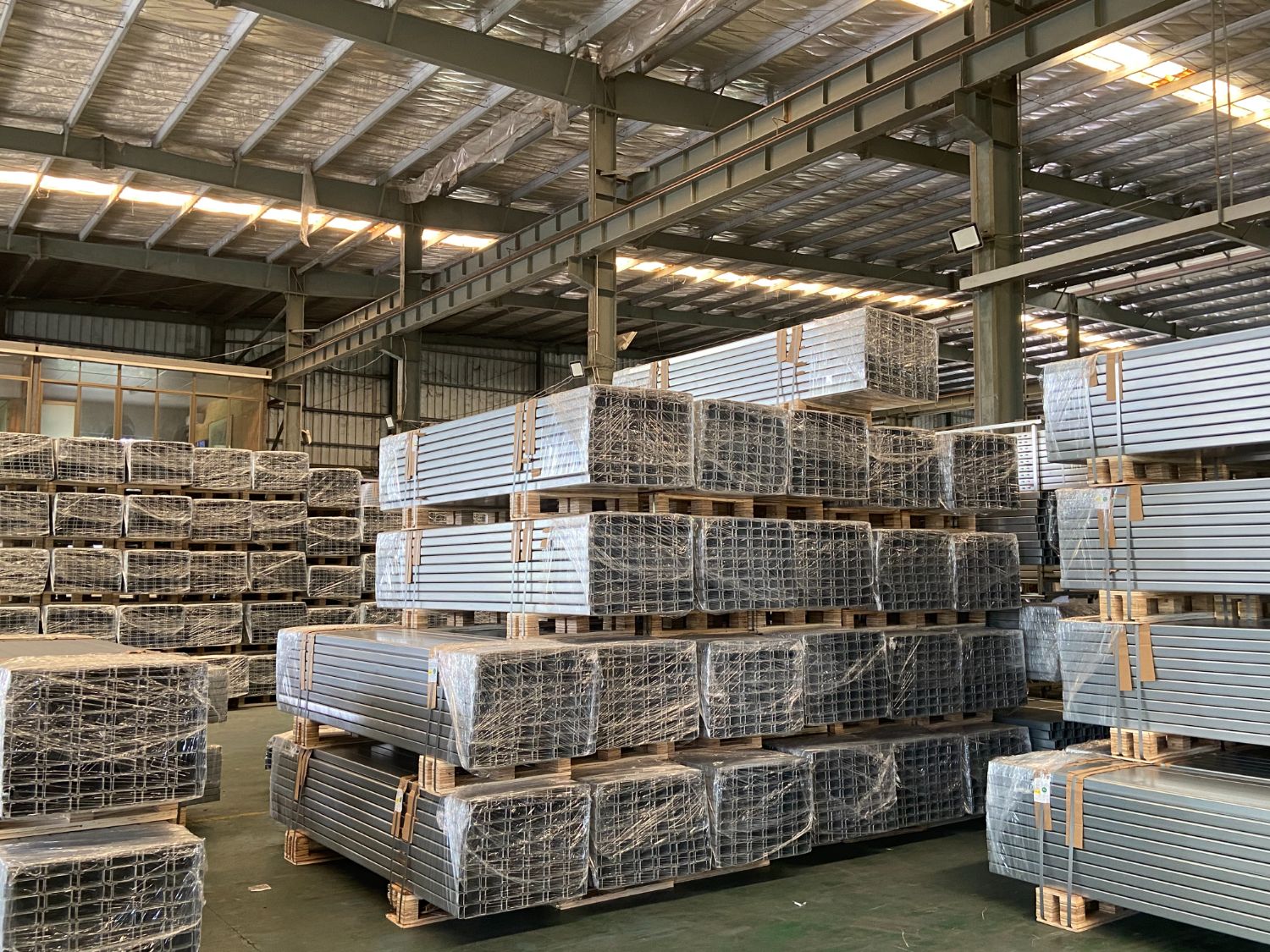
Long steel rails demand more than a standard wooden box. Our export crating system uses a segmented internal cradle that locks each rail into a fixed position, preventing micro-shifts during ocean transit that often cause abrasion or bending. Instead of relying on loose foam or generic bracing, we machine custom saddle blocks from high-density polyethylene to match the exact rail profile, distributing pressure evenly across the length.
Moisture and salt spray are the silent destroyers of precision rail surfaces. Each crate is lined with a vapor-barrier film and includes desiccant ports that allow for easy replacement without opening the main enclosure. The outer shell is built from heat-treated lumber with interlocking corner joints, then wrapped in a UV-stabilized waterproof membrane. This layered approach means the rail arrives at the destination dry, clean, and free of rust blooms even after weeks in a humid port warehouse.
For rails exceeding twelve meters, we split the crate into modular sections that bolt together around the load rather than sliding over it. This eliminates the need for overhead cranes with extremely high clearance and reduces the risk of edge impacts during packing. Forklift channels are reinforced with steel angle inserts, and the entire package is tipped and shaken on a vibration table before sealing to confirm that no internal movement occurs. The result is a crate that treats a long rail not as a commodity, but as a precision component that cannot afford a single scratch.
FAQ
They are not just price-driven workshops. Most have dedicated extrusion lines for 6005-T5 and 6063-T6 profiles, run in-house anodizing or powder coating, and can show consistent batch-to-batch tolerances under ±0.5 mm. Several also hold ISO 9001 and have passed salt spray tests of 1,000 hours or more.
The bulk of them operate in Jiangsu, Zhejiang, and Guangdong. You will also find a few in Shandong and Anhui. Being near raw aluminum suppliers and export ports like Shanghai, Ningbo, and Shenzhen cuts both material cost and delivery time.
Customization is the norm, not the exception. Most of these factories accept drawings for specific hole spacing, slot sizes, and rail lengths from 1 to 7 meters, and several can add crimping or pre-assembled grounding clips if requested.
At minimum, request ISO 9001, material mill certificates for the exact alloy, and a recent salt spray test report. For markets like Europe or Australia, also ask about REACH or RoHS compliance, and if possible get a third-party SGS or TÜV inspection before shipment.
Most mid-sized plants can extrude and finish 200 to 500 metric tons of aluminum per month, but only part of that goes to solar rails. For a single rail profile, expect 50 to 150 tons monthly depending on current order books and die availability.
They typically apply an anodized layer of 10 to 15 microns or a polyester powder coat of 60 to 80 microns. The better ones also control alloy composition tightly and avoid recycled scrap that can cause pitting, then validate with neutral salt spray tests exceeding 1,000 hours.
For standard profiles, many will accept 500 to 1,000 meters as a trial order, especially if you pay a slight surcharge. For custom dies or non-standard punching, the MOQ often jumps to 3,000 meters or more because of setup and die costs.
Direct sourcing gives you better price transparency and easier technical communication, but trading companies can consolidate small orders and handle export paperwork. If you choose a factory from this list, request a video tour of the extrusion and coating lines and ask for at least two recent client references in your region.
Conclusion
China's solar aluminum rail manufacturers have moved far beyond supplying simple extrusions. The best of them now treat rail straightness as a non-negotiable, locking it in directly on the extrusion lines rather than relying on downstream corrections. This matters because even a slight bow can throw off module alignment across a long span. At the same time, the alloy blends have been tuned for brutal field conditions—salt spray near coasts, intense UV and heat in deserts—so the rails won't quietly corrode or lose structural integrity after a few seasons. What really separates the top factories, though, is how they handle custom work. Instead of forcing buyers to wait weeks for new tooling, many have built flexible punching and drilling setups that can produce custom hole patterns with little to no lead time penalty. That kind of responsiveness changes the calculus for project planners who are tired of standard hole spacing dictating their design.
Surface finishing is another area where these factories have expanded well beyond the default silver anodizing. Durable powder coats in black, bronze, and even custom colors are now offered without absurd minimum order quantities, giving installers more control over aesthetics and corrosion resistance. But all of that would mean little without tight dimensional control. Leading shops measure rail tolerances in microns before anything leaves the floor, checking straightness, twist, and hole position against digital inspection records. Finally, export crating has been rethought for the realities of long, slender profiles. Proper bracing, foam separators, and reinforced end caps keep 6-meter or longer rails from arriving dented, scratched, or bent. That combination of precision, material science, flexible customization, and careful logistics is why a handful of Chinese factories deserve serious attention from anyone sourcing solar mounting rails.
Contact Us
Contact Person: Leite
Email: [email protected]
Tel/WhatsApp: (+86)13666072898
Website: https://www.egretsolars.com/